Q&A with 2025 spring graduate, Shrey Narayanan
On May 9-10, UW–Madison and the School of Education will celebrate its latest cohort of talented graduates with 2025 Spring Commencement celebrations. Ahead of this big weekend, we reached out to a few of our graduating students to learn more about their accomplishments, time at UW–Madison, and future plans.
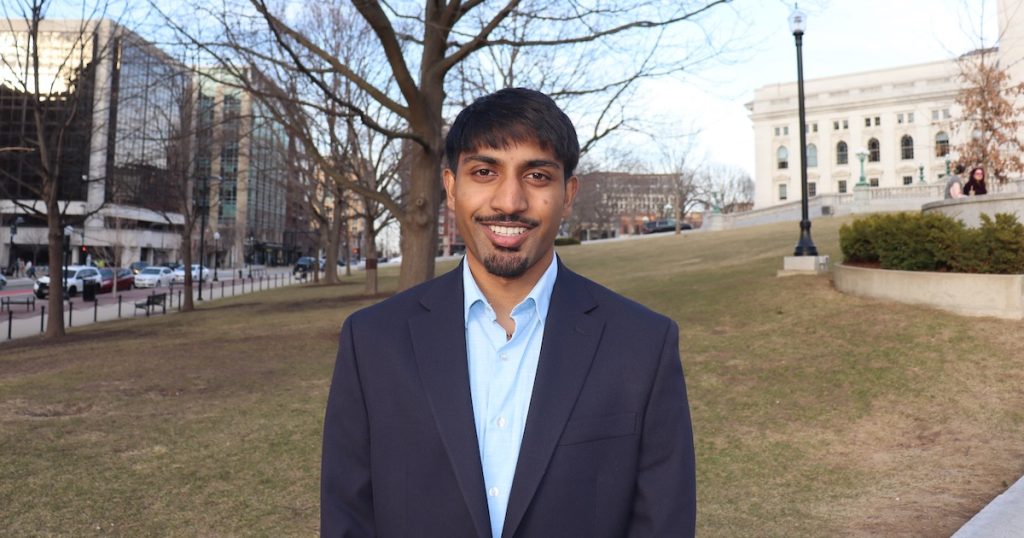
Shrey Narayanan, who is graduating with a BS in Kinesiology and a certificate in Athletic Healthcare, is one student who agreed to share his thoughts with us.
While on campus, Narayanan contributed to research in the Barnes Lab, which investigates how aging affects blood flow regulation in humans and its connection to cardiovascular disease and dementia risk. Beyond the lab, he embraced opportunities to give back — volunteering as a peer learning facilitator for physiology students and supporting older adults through the Hospital Elder Life Program (HELP) at Meriter Hospital.
Following graduation, Narayanan plans to apply to medical school with the goal of becoming a physician who not only cares for individual patients, but also strengthens community health. “Being a physician gives me a platform to help promote public health and the well-being of the families in Wisconsin,” he says. “I want to treat patients and also have positive impacts on their families, educating them how to navigate various resources to help improve their quality of life.”
Read on to learn more about Narayanan and his time with the School of Education’s Department of Kinesiology:
Where are you from, and what brought you to UW–Madison? I’m from Pewaukee, the home of some UW–Madison legends. Going into high school, I had a skateboarding accident. After being exposed to great patient care in the ER and hospital, I took advantage of the Insight Health and Medicine Program at Pewaukee High School. I knew I wanted to go to a college where there were many opportunities to nurture my passion for healthcare further.
Additionally, I was raised by two immigrant parents from India who are incredibly resourceful and have sacrificed a great deal for my future. Choosing UW–Madison gave me the best of both worlds: I could attend a world-class institution that supported my interest in healthcare while also staying close to home. Being near my family meant I could share this new chapter of my life (the American college experience) with my parents, who never had the opportunity to go through it themselves.
I also wanted a university that gave me the opportunity to learn about other cultures and express my own Indian heritage. I wanted a university that could help me pursue healthcare and also had accessible clubs/organizations that would help me share my culture and learn from others. Looking back at my time at UW–Madison, this institution provided me with just that.
What was your most meaningful experience at UW–Madison? My most meaningful experience would be the Kinesiology program as a whole — it’s difficult to pick a specific thing within it. Not only did the major align with my interests, it allowed me to join a pretty neat physiology research lab with Dr. Jill Barnes and also helped me work as a peer learning volunteer and facilitator (essentially an undergraduate TA and tutor) for physiology 335 with Professor Lokuta and Professor Walsh.
The program has a lot of great resources. I was happy to be a student in this program with such meaningful faculty who are approachable and resourceful. This program helps shape us into better humans.
Can you share a bit more about your work in the Barnes Lab and your volunteer experiences? Initially, I came into UW–Madison thinking I was going to apply to PT school. People suggested looking at Kinesiology as a major, so I reached out to Dr. Morgan Shields. My values of physical well-being, exercise-science, and holistic treatment programs confirmed my decision to major in Kinesiology.
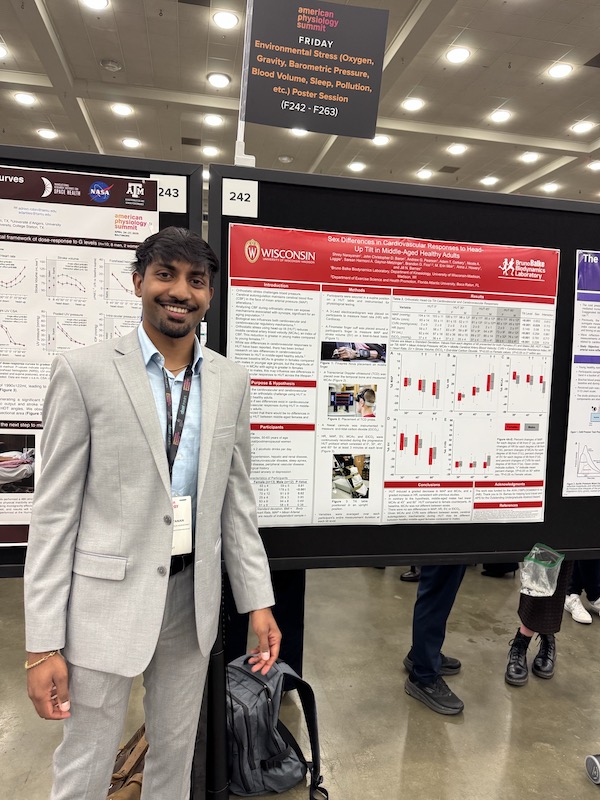
I wanted to get involved with research, so I looked for labs within Kinesiology. After getting into the Barnes Lab, I started reading about what they research and how it’s done. Our lab is focused on brain blood flow and how it is regulated in participants undergoing different interventions. Personally, I spent a lot of time analyzing and grouping data, observing studies, and then eventually working on my own projects. I’ve written abstracts and created posters based on data I analyzed. These were showcased at UW’s Undergraduate Symposium and presented at the APS Summit in Baltimore in late April. The Barnes Lab was perfect for me because I could continue my research in the Kinesiology Practicum course required for all undergraduate students. This lab also made me feel like I was contributing to the field of preventative medicine — analyzing brain blood flow in older populations and trying to gather information on how to ensure proper brain blood flow at these ages. This is important to delay the onset or prevent cognitive decline/conditions that are related to poor brain blood flow, which my family has a history of.
My research got really interesting after taking physiology. I started to understand what our lab does to a greater extent, furthering my passion for both the Barnes Lab and physiology in general. I wanted to share my passion and motivate other students, so working with the teaching faculty as a peer learning volunteer for physiology allowed me to do so. I was able to help during the in-class workshop activities and lead my own small tutoring group. Both experiences were great because I was able to give back to the department. It was rewarding to be a resource for students, sharing tips and tricks on how I approached the content. I wanted to share my successes and failures with students, because the class can be daunting and lead to some students not appreciating the course. Sometimes it can be difficult for the instructors to take the perspective of students, so me being a prior student really helped me connect and guide the students I was teaching.
At Meriter Hospital, I am able to connect with patients through the Hospital Elder Life Program (HELP). The patients I see are at high risk of hospital delirium. Thus, they can really use the companionship and support that our program offers. Some patients need help with meals, and also support while walking around the hospital. As a HELP volunteer, I am able to step in in these contexts. This role led to me creating some meaningful relationships. Unfortunately, some of these patients are admitted for weeks, so you start to get to know them. Fortunately, many of these patients enjoy the company and sharing their life experiences. It can be difficult for the hospital staff to connect with each patient given there are numerous things to do — that’s what makes my role special. We are encouraged to spend as much time as we can with our patients. Interacting with the patients not only made my days brighter, but I knew that these simple tasks were preventing hospital delirium and cognitive decline.
What’s next for you? What are your plans for the future? I’ll apply to medical school for the 2026 cycle. Meanwhile, I want to continue working in my research lab in some capacity, and I will move back to home and work as a medical assistant at Aspen Orthopedics — saving money on rent and also gaining more clinical experience.
I’d also like to travel somewhere in the southwest and go hiking. Or maybe travel out west and do the same.
Thinking about the principle of the Wisconsin Idea, how will you use what you have learned at UW–Madison to influence other people’s lives or positively impact our world? As stated, I will be applying to medical school. My dream school is UW’s medical school because it has public health as a core value in its curriculum. Being a physician gives me a platform to help promote public health and the well-being of the families in Wisconsin. I want to treat patients and also have positive impacts on their families, educating them how to navigate various resources to help improve their quality of life.
As a physician, I can go into research to continue advancing medical technologies and intervention for the betterment of patient populations. I could even take on an educator role, either training another generation of medical students or look for ways to educate my local community. I don’t know where I’ll specialize and what I want to do specifically, but I know that as a physician there are many ways where I can reach families in Wisconsin and positively impact them.