Greater Madison Writing Project helps educators write to become better teachers
In a room overlooking the summer blooms at Madison’s Olbrich Gardens, 10 educators sit with notebooks open as UW–Madison School of Education Dean Marcelle Haddix speaks.
“I strongly believe that you can’t be a teacher of writing if you yourself don’t identify as a writer,” Haddix says. “I really appreciate spaces like this that provide opportunities for educators to cultivate the writers in yourselves and be in a community of practice and feel like you’re finding your people.”
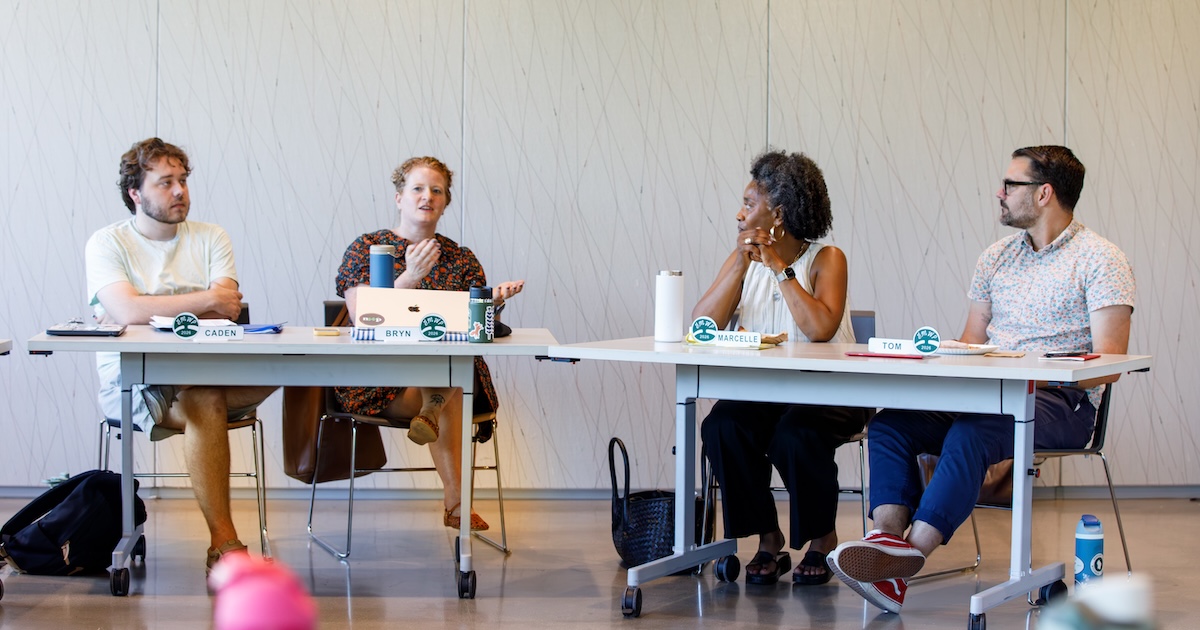
For the teachers assembled at the Greater Madison Writing Project (GMWP)’s Summer Institute, that idea lies at the heart of why they have chosen to spend a portion of their summer break back in the classroom. Haddix recently joined this year’s participants for an afternoon of conversation and learning.
Since 2011, the Greater Madison Writing Project has brought together educators from across Wisconsin and beyond for a three-week exploration of how to teach writing across all grade levels, from kindergarten through college. The Summer Institute immerses teachers in writing, reading, research, and reflection, preparing them to return to their schools as leaders equipped to support their colleagues and help students discover the power of writing in their own lives.
While each component of the institute plays an important role, GMWP co-director Mark Dziedzic says it is the opportunity to learn alongside fellow educators that distinguishes the program.
“The most important aspect is that we engage in all of the practices together and in community,” he says.
That sense of community is a defining feature of the Summer Institute, echoes Bryn Orum, who participated in the inaugural cohort in 2011 and now co-directs GMWP alongside Dziedzic.
“The Summer Institute is a transformative experience,” Orum says. “We know teaching is a challenging job, but it can also be an isolating one. The community established in the Summer Institute encourages both meaningful learning and sharing of expertise.”
That experience, Orum adds, often stays with participants as they return to their schools.
“Our teacher-leaders leave the institute looking forward to creating the kind of nourishing learning opportunities they experienced here in their own classrooms.”
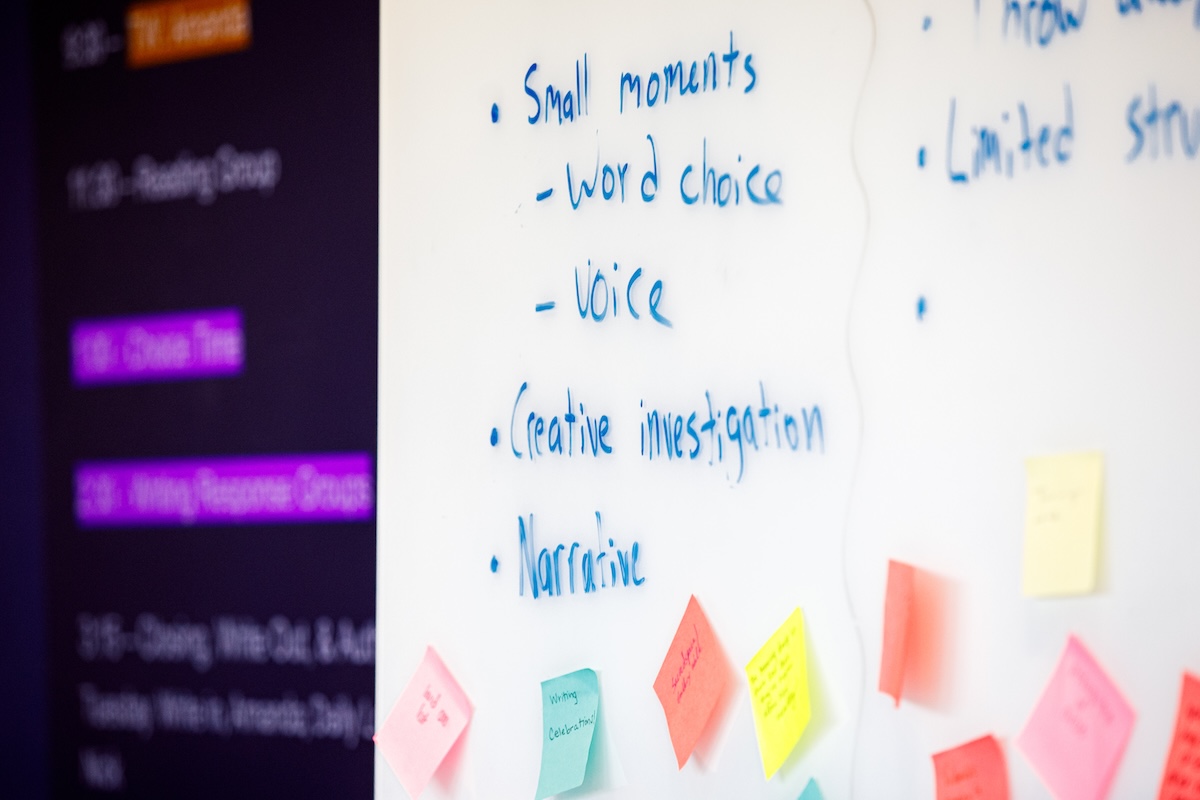
The philosophy that teachers become more effective writing instructors when they are writers themselves shapes the institute’s daily rhythm.
Each day begins with journaling and concludes with a “write-out” and author’s chair, where participants share their work with one another. Throughout the program, participants are given dedicated time to cultivate their own writing practices, experiment with new forms of expression, and reflect on their experiences.
“We’ve been writing, and writing, and writing,” says Ollie Harris, a recent graduate of UW–Madison’s Secondary Education master’s program who now teaches social studies at MG21, a project-based school for middle- and high-school students based in Monona, Wisconsin.
The emphasis on writing is paired with inquiry. Every participant arrives with a question or area of interest related to writing instruction that they hope to explore. Over the course of the institute, they conduct research on their chosen topic and lead a discussion about it with their cohort.
Participants also read and discuss a variety of books about writing, including “On Writing” by Stephen King, “What It Is” by Lynda Barry, “Bird by Bird” by Anne Lamott, and “Old Friend from Far Away” by Natalie Goldberg.
For Haddix, as with GMWP, the importance of writing extends beyond English classrooms.
“In every discipline, everything that we do, writing, composition, expression has to be a part of it,” Haddix says. “We need to make sure our students feel these are important tools, whatever they decide to do.”
After the discussion, the group transitions into end-of-day choice time. Some participants wander through the nearby gardens while others settle into quiet corners to read, write, or work on their research projects. Haddix remains behind to speak with GMWP alumni about the program’s lasting influence on their teaching and professional lives.
Again and again, alumni return to the theme of community.
“Any time I’ve felt hopeless or overwhelmed by things happening to me as a teacher, I’ve found empowerment here,” says one alumnus.
“There’s always new people coming in, new ideas, new perspectives, and new folks,” reflects another.
One educator likened GMWP to a prairie ecosystem.
“It’s a beautiful prairie with all these different elements in it that keep flourishing and receding,” she says
That beauty, she adds, “comes from teachers who are committed, passionate, in conversation with one another, drawing on expertise, and grounding their work in research.”
“Together, they create a flourishing community for everyone. That’s the beauty I’ve found in the writing project and what continues to keep me connected to it.”