Three from School of Education honored with 2026 awards for mentoring undergraduates
Three members of the UW–Madison School of Education community have received 2026 Awards for Mentoring Undergraduates in Research, Scholarly, and Creative Activities.
The honorees include Brendan Eagan, scientist in the Wisconsin Center for Education Research; Valerie Hammer, graduate student in the Department of Curriculum and Instruction; and Shamya Karumbaiah, assistant professor in the Department of Educational Psychology.
The awards are offered by the Office of the Provost and Division for Teaching and Learning to recognize the important role mentors play in fostering undergraduates’ intellectual, personal, and professional growth through participation in high-impact practices including research, scholarly, and creative endeavors.
Following are profiles of this year’s School of Education awardees, written by Meredith McGlone:
Brendan Eagan

Under Brendan Eagan’s mentorship, undergraduate interns in the Epistemic Analytics Lab regularly do work that in other labs would be done by PhD students or postdoctoral fellows — developing web-based software applications, helping to devise and test new statistical techniques, and performing complex analyses of data for researchers all over the world. That undergraduate brainpower has directly contributed to the lab’s own growth, says Eagan’s supervisor, Andrew R. Ruis. “The quantitative ethnography community, which consisted of only a few dozen researchers when Brendan began this work, now numbers more than 1,000 scholars on all six inhabited continents, and a big part of that growth was due to the way Brendan built and mentored a team of high-performing undergraduate interns.” Eagan also pays close attention to his interns’ own professional growth. “He identified my strengths and provided opportunities for me to step into — from leading a meeting, to a project and clients, and later a full team,” says former intern Clare Porter. “During my time at Epistemic Analytics, every intern left the lab with at least one short paper publication, experience working on a project across the entire pipeline, and a strong network of researchers with whom they’d worked.” Porter is now a research assistant at the Rand Corp. — other interns now work for Amazon, the Federal Reserve, and the National Opinion Research Center, among others.
Valerie Hammer

A pivotal time in an elementary education student’s journey comes when they have their first teaching experiences. Valerie Hammer has mentored many recent students through this process, observing them, giving feedback, and helping them build strong relationships with the teachers they’re working with. “She showed us how to make learning fun while still meaningful,” says student Carly Hersch. “She shared practical strategies I know I will use forever, such as writing activities where students do not even realize they are completing a writing prompt until they suddenly have an entire scene or story.” Hammer makes a point of tailoring students’ experiences in the program and seminars to their interests, asking them what community resources they’d like to learn about and then arranging opportunities to learn from or visit local organizations like the public library and the zoo. “Val is the type of person who will always listen to others because she is genuinely interested in what each person has to say,” says student Noelle Anderson. “She is just as interested in learning from individuals as she is teaching them. … If I could be a fraction of the teacher Val is, I would consider myself incredibly successful.”
Shamya Karumbaiah
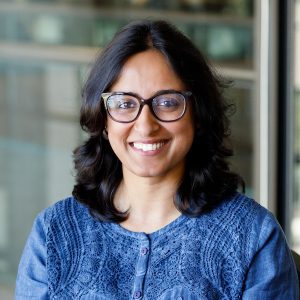
Shamya Karumbaiah’s lab — The Responsible AI for Learning (TRAIL) Lab — studies an important, timely topic, so it’s not surprising that lots of students want to work with her. While she’s still early in her career, she’s already worked with 35 undergraduates from a wide range of disciplines — computer sciences, information science, data science, statistics, and linguistics. Most of her mentees plan to pursue graduate degrees, and she develops individualized learning goals surrounding research practices, methods, and academic writing for each student. “The results of this elaborate mentoring model have been quite impressive. The majority of her students consistently re-enroll in following semesters, an unmistakable endorsement of the invaluable learning experience, supportive culture, and high level of engagement that she has fostered,” says Jennifer Asmus, professor and chair of educational psychology. Her collaborations with undergraduates have also resulted in 13 publications in major international conference proceedings. “Looking back at my time in Dr. Karumbaiah’s lab, what strikes me most is how the relationship itself grew. It was always reciprocating and continuously evolving,” says 2025 graduate Tanay Nagar. “The work I did under Dr. Karumbaiah’s guidance has been foundational to who I am as a researcher today. It shaped my research questions, sharpened my technical and analytical abilities, and gave me the confidence to pursue graduate study and lead independent research initiatives.”
Learn more about the 2026 awardees.