By Isabelle K. Dunai
When Estevan Molina arrived at the airport, he carried a suitcase filled entirely with basketballs.
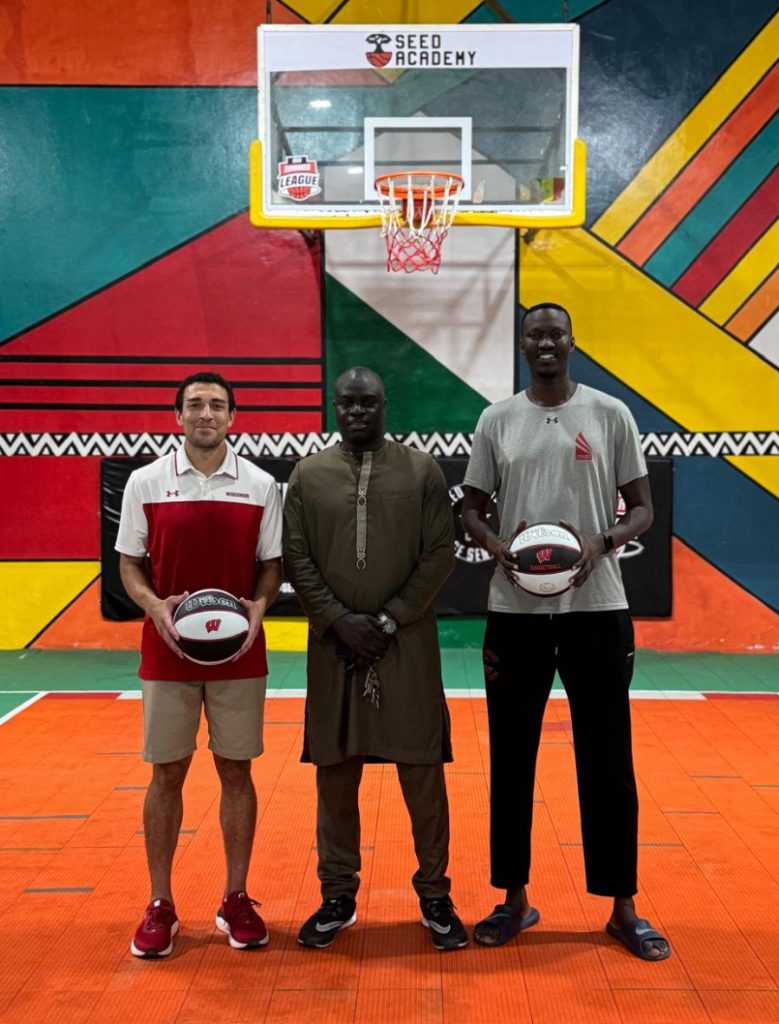
About 40 of them — all different sizes, all donated by UW–Madison’s Athletic Department, and all deflated — were squeezed into a checked bag. The plan was clear: deliver them to youth programs and basketball academies across Senegal.
But the basketballs weren’t the main reason for the trip.
Molina, a PhD student in the Educational Leadership and Policy Analysis program and a School of Education Graduate Research Scholar, researches the intersections of education and sports. This September, he traveled to Senegal to better understand the academic, cultural, and structural systems that shape how players move from countries like Senegal to U.S. colleges. This trip was supported by the Global Engagement Office’s International Summer Research Award, which helped make the research possible.
His work is connected to Badger Inquiry on Sport (BIOS), a research lab formed through a partnership between the School of Education and UW Athletics to bring top-level research and athletics together.
“If coaches or administrators have questions or just need more information … they come to us,” Molina says.
The spark was lit for Molina’s research trip after the UW men’s basketball coaches approached BIOS with a curiosity: How does international recruiting work — and what should Wisconsin be doing to support international players once they arrive?
The coaches wanted to learn more about what recruiting looks like, what countries are sending athletes, and what kinds of social support and academic support matter most.
“That started the whole inquiry into this,” Molina says. “I took it as my own project … and went down a rabbit hole with everything and then got connected with Megan [Soderberg] through the athletic department.”
Soderberg — a UW–Madison alumna and a former student manager of UW men’s basketball from 1996 to 2000 — helped Molina trace the pipeline of international students playing in the U.S. back to its source. She has been heavily involved with several organizations and efforts supporting international athletes coming to the U.S. Given Soderberg’s preexisting relationships with student-athletes and their families in Senegal, she helped Molina plan his travels and joined him during his time in Senegal.
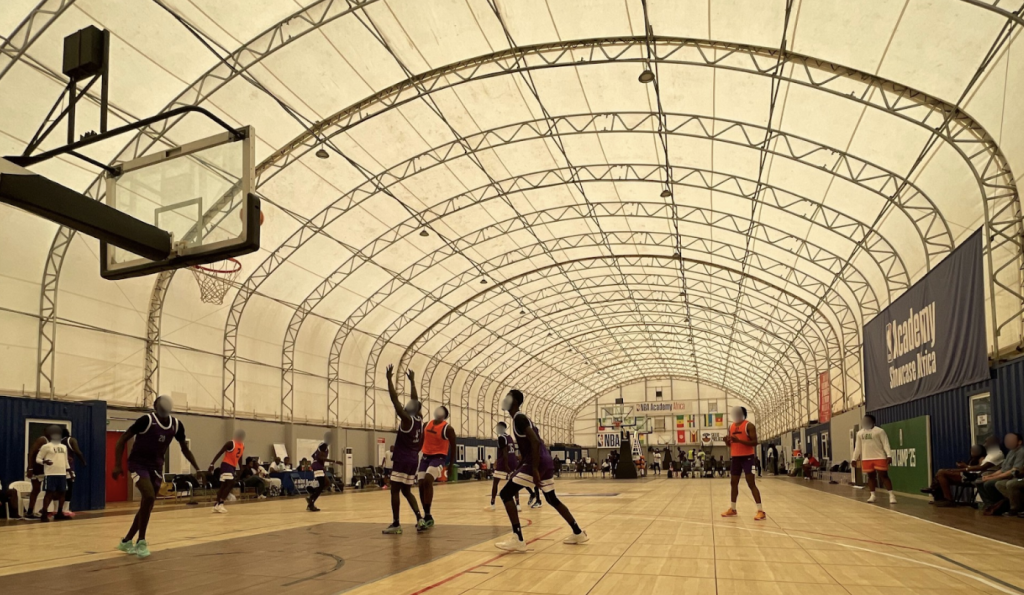
In Senegal, basketball development often happens in academies that combine education and training, Molina notes. One example, according to Molina, is the NBA Academy, which operates as a professional pathway, often identifying top prospects and flying them internationally for competition.
Senegal’s SEED Academy is the first basketball academy in Africa. Founded in the late 1990s, it emphasizes both academics and athletics with its mission grounded in community impact. Since they have a set amount of dorms available for the boys and girls who apply, the SEED Academy is more selective and hosts tryouts, according to Molina. Similar to the NBA Academy and the SEED Academy, Senegal’s Flying Star Academy has also produced many professional and collegiate basketball players.
“They [Flying Star Academy] produce a lot of college players, which is really interesting because it’s an outdoor court,” Molina says. “They accept anybody so there’s kids who just learned to play basketball and kids who are going to come over here in a couple of months and play in front of 20,000 people. I think that’s pretty cool.”
Over nine days, he visited basketball academies like SEED, spoke with administrators, and met families of players currently studying in the U.S. One of the families they visited has a son playing basketball in the U.S. and Soderberg’s family once hosted him.
Initially, Molina planned to record formal interviews to conduct his research, but quickly shifted his approach.
“As soon as I got there, I was talking to the first person I met [with a recorder]. It felt really uncomfortable,” he says. “I want to work with a lot of them long-term, so I didn’t think it’s worth starting the relationship off like a professional interview.”
Instead, he relied on conversations and building connections. During his trip, a typical day included having a meal with a basketball academy family, visiting a school or basketball club, and connecting with families whose children were in the U.S. playing basketball.
As he conducted his research, Molina kept a key goal in mind of how his work could benefit the students in basketball academies and their families.
“It’s become a big research project … A lot of these kids do need assistance [when making the transition to the U.S. for school],” says Molina. “The more support they can get from trusted people, the better.”
Seeing where these athletes have grown up — and the resources available to them — has added depth to his research on the hurdles and struggles international students and immigrants face, according to Molina.
“With all the changes with athlete compensation at the college level, it’s different for international athletes,” says Molina. “And obviously, there’s the cultural, educational differences and transitions.”
And then, there were the basketballs.
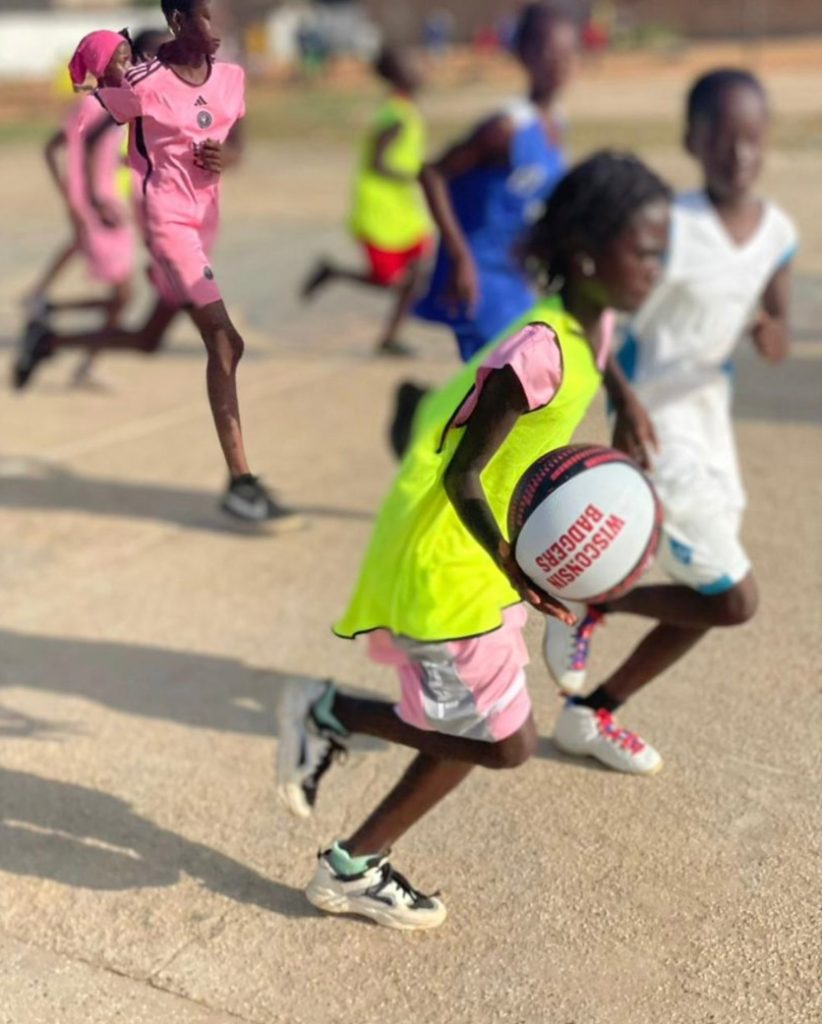
At his stops throughout Senegal, Molina would unpack the overstuffed suitcase, handing basketballs to the academies and programs. The gift and contribution may be small in comparison to the broader research questions, but it symbolizes a core philosophy of the trip: knowledge moving in both directions.
“My ultimate goal is to help the athletes, the coaches, and their families,” Molina says.
As for the possibility of returning to Senegal for future research, Molina hopes it could one day involve a trip with some of the Senegalese boys and girls who are currently student athletes in the U.S.
“I don’t know if that would be possible, but I think that would be cool. They can tell us the whole story.”