Amanda Palmen’s third grade classroom at Crestwood Elementary School hums with restless energy. Students wiggle and whisper on the rug, buzzing with anticipation. Today isn’t just another school day — it’s Whoopensocker day.
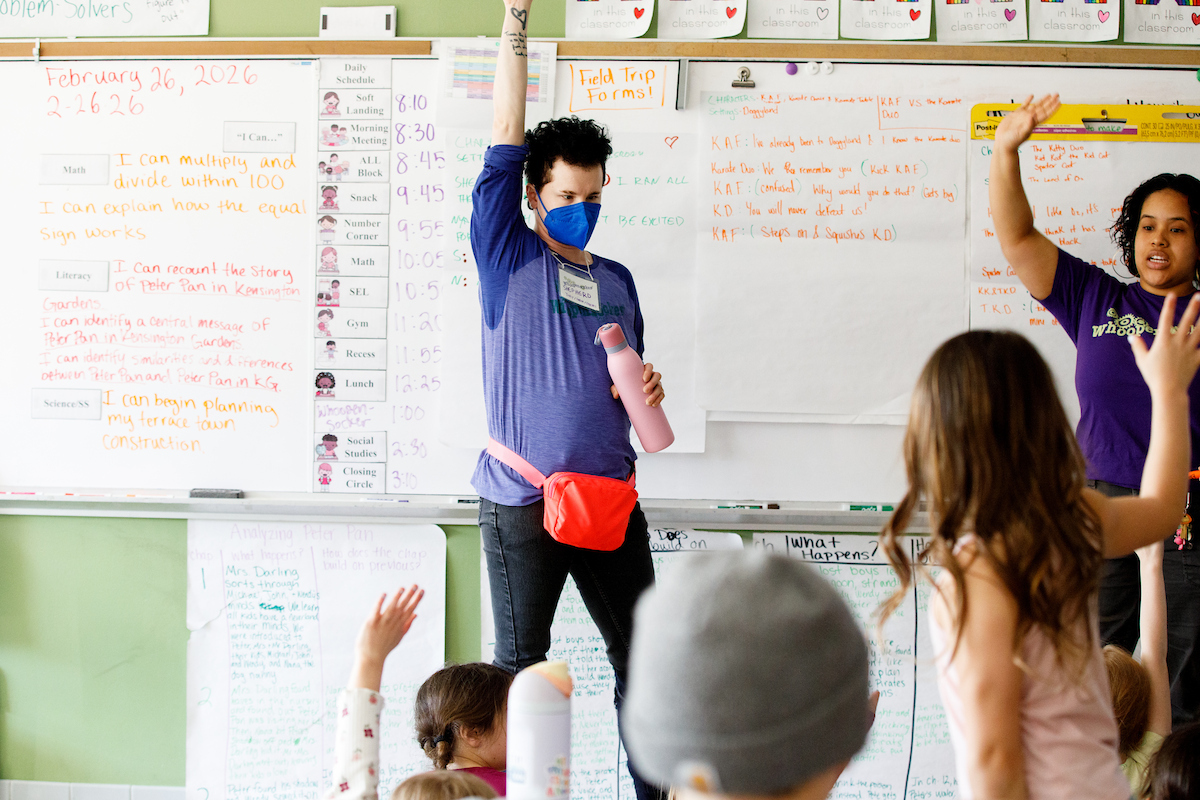
This afternoon, Shepherd Sightless and Nyame Imani, Whoopensocker teaching artists, are visiting the classroom, as they have for the past several weeks. Their goal: use theater as a tool to teach creative writing.
Wearing bright purple Whoopensocker T-shirts, they step into the center of the room. Sightless raises a hand and calls out, “Whoop it up?”
The students fire back in unison: “SOCK IT TO ME!”
“Are we ready to play some games? What do you want to start with?” Sightless asks.
A wave of voices crashes back: “PIZZA MAN!”
Excitement ripples across the carpet; a few kids bounce a little too enthusiastically.
Imani offers a gentle reset: “If you can hear me, touch your nose.”
Instantly, hands move and the room settles.
The rhythm is a familiar one across dozens of classrooms in the Madison area. Every year, pairs of Whoopensocker teaching artists visit elementary schools to lead creative writing lessons built on a bedrock of theatre exercises and principles, including improvisation. Founded at UW–Madison by School of Education faculty member Erica Halverson in 2015 and housed in the School’s office of Professional Learning and Community Education (PLACE), Whoopensocker was created with the belief that integrating the arts into classroom work can invigorate learning.
During their six-week residencies in schools, Whoopensocker teaching artists arrive with a vibrant toolkit of games, storytelling prompts, and community-building practices that invite students to share their ideas both in writing and out loud.
In Palmen’s room — just as in every residency — they begin in a circle. Games like “Pizza Man” spark connection and laughter. From there, students move into skill-building: learning how to write scripts, experimenting with dialogue and character development, and drafting their own stories in notebooks they get to keep.
“So it’s not like one story is written and then it’s lost — they can take them home,” Palmen says. “I’ll encourage the kids to write in it during the week, or have it as a rotation in my literacy block.”
Every residency culminates with a full performance at the Madison Youth Arts Center (MYArts), where professional actors bring the students’ stories to life onstage.
Palmen says it’s a model that gets even the shyest kids to open up.
“I’ve seen some of my quieter students really enjoy sharing in front of the class, getting out of their shell, wanting to be creative,” she says.
Coming full circle
This isn’t Palmen’s first encounter with Whoopensocker.
A recent graduate of the School of Education, she first discovered the program while completing the Arts in Teaching certificate. She remembers a pivotal moment in a course on arts integration taught by Halverson.
In one class session, Whoopensocker teaching artists led a mock first‑day lesson for the college students.
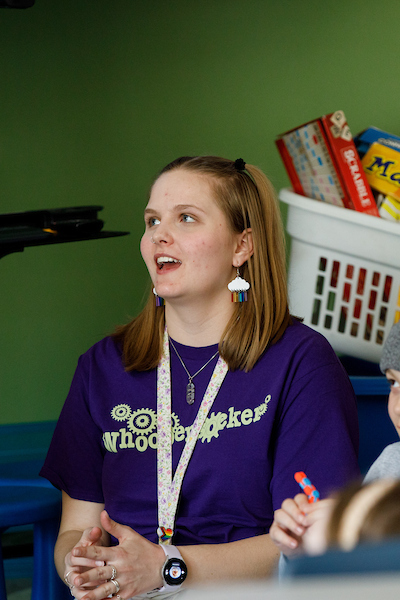
“I remember thinking: If I were a kid, I would have had a blast in that classroom,” reflects Palmen.
Later, Palmen worked as a Whoopensocker teaching artist during a practicum in a fourth‑grade multilingual classroom at Lincoln Elementary.
“It really helped me grow,” she says. “It modeled the ‘I do, we do, you do’ gradual‑release structure so well. And it showed me how important it is to make space for fun and creativity — even when we’re focused on spelling, informational writing, research, all the hard work in literacy. It reminded me that fun builds confidence.”
In just six weeks, she saw remarkable changes.
“I only saw the students for an hour and a half each week, but from beginning to end, some became so much more confident — in themselves and in their writing. And then seeing the final show and thinking, ‘That’s a story one of my students wrote!’ It opened my eyes as an educator.”
Palmen describes herself as a “by‑the‑book” teacher who wants to follow all curriculum expectations.
“But this showed me it’s just as important for kids to feel good about their writing,” she says.
So when Crestwood’s principal announced that Whoopensocker had approached the school about doing a residency, Palmen didn’t hesitate.
“I was immediately like, ‘Yes, let’s do it!’” she says. “I was super excited because I’d been a part of it.”
“Having them in my class feels very special,” she adds. “I know it’s such a good program, and I can see how good it can be for students. It’s also fun for me because I know what to expect and have a deeper understanding of what their goals are as teaching artists. It’s really nice to be able to jump right in.”
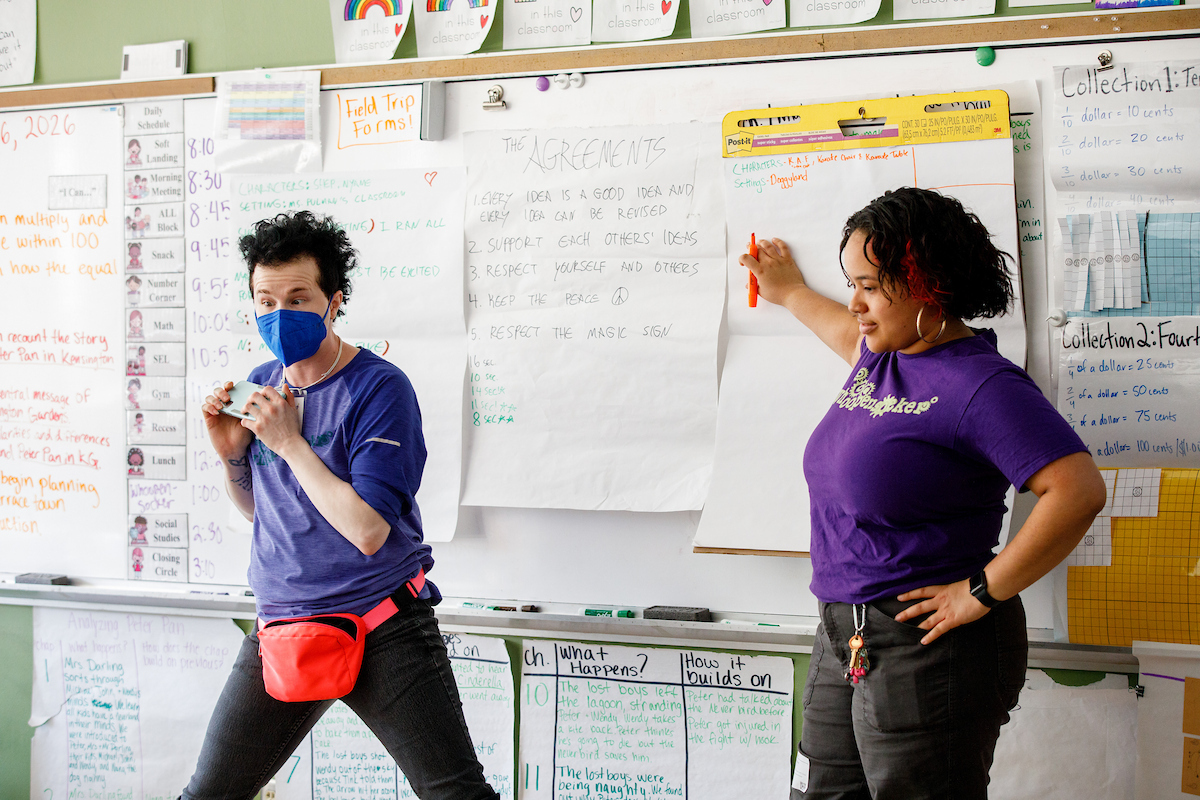
Back in Palmen’s classroom, Imani turns to the group.
“Are you ready to play the game — the one you voted for? Pizza Man?”
The students erupt. Now Palmen steps into the circle.
“Okay this is a repeat after me song,” she says.
“This is a repeat after me song!” the class echoes.
She smiles and begins the familiar chant — she first learned as a UW student, now a teacher:
“Hey-eh bo diddly bop.”
“Hey‑eh bo diddly bop,” the students repeat.
“I’ve got to get back to my block.”
“I’ve got to get back to my block!”
“With a pizza in my hand.”
“With a pizza in my hand!”
“I could be a pizza man!”
“I could be a pizza man!”
Their voices rise and fall together, setting the stage for an afternoon filled with creativity, fun, and learning.