On Sunday, Dec. 17, UW–Madison and the School of Education will be celebrating its latest cohort of talented graduates with 2023 Winter Commencement celebrations. Ahead of the big day, we reached out to a few of our graduating students to learn more about their accomplishments, time at UW–Madison, and future plans.
Lena Lee, who is receiving her master’s degree from the School of Education’s Department of Educational Leadership and Policy Analysis — with a focus on higher education and student affairs — is one student who agreed to share her thoughts with us.
Lee began her time on the UW–Madison campus as a PEOPLE Scholar en route to earning an undergraduate degree in psychology. She also earned a certificate in Asian American Studies, with a Hmong American emphasis.
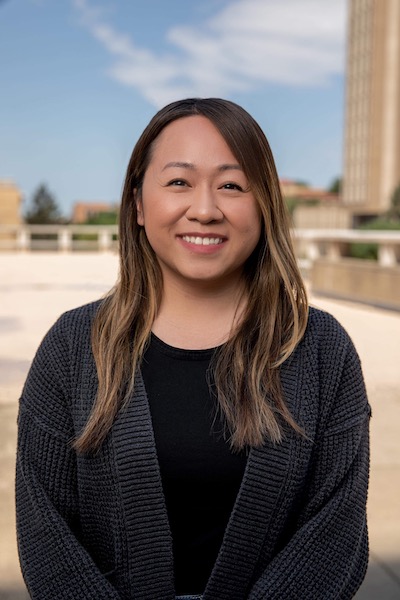
Bailey Smolarek, a researcher with the Wisconsin Center for Education Research, met Lee five years ago when she joined the Our HMoob American College Paj Ntaub team as an undergraduate student researcher.
“She was an integral member of our team for three years and has stayed close with us after moving on to earning her master’s degree,” says Smolarek. “Lena uses her personal experiences as a first-generation college student and daughter of Hmong refugees to inform her scholarship and work with underrepresented students.”
To learn more about Lee and her work, check out this Q&A:
Where are you from, and what brought you to UW–Madison? I’m from Madison and I never considered going elsewhere for undergrad. Madison is home and attending UW–Madison felt like the natural step to take after high school. I also had a scholarship through the PEOPLE Program, so my tuition was covered. After graduating during the pandemic in 2020, I took a break and began working at the Office of Academic and Career Success (OACS) at UW–Madison. This time, I considered doing my master’s elsewhere, but I stayed because of the strong, supportive community of advisors, career services professionals, and learning support staff. I found it hard to envision myself anywhere else without them and their support. They’ve really helped me throughout grad school, and I don’t regret staying.
Can you share with me a little bit about your background and why working to serve underrepresented students at the university is important to you? My parents came to the U.S. as refugees of the Vietnam Wars in the mid-80’s. They didn’t go to college, but they saw the benefits of higher education and how it leads to greater career opportunities. However, what stood out for me was seeing how education can be used as a tool for activism. Throughout K-12, I saw many women in leadership roles — something I rarely saw in my own culture. I learned about leaders from similar backgrounds as me and it exposed me to different ways of living and different worldviews. Education allowed me to rebel against gender norms and societal expectations by providing me with leadership opportunities. It allowed me to dream of a better, more equitable world. Now that I’m graduating, I’d like to improve higher education for those who are using it as a tool for activism and to support their acts of rebellion.
Tell us about your research or research interests. For three years, I was part of the Our HMoob American College Paj Ntaub research team within the Wisconsin Center for Education Research (WCER). We examined the HMoob American college student experience here at UW–Madison. The participatory action research requires a lot of reflection through autoethnography. Through research, and specifically with autoethnography, I began understanding why I was struggling so much during undergrad. As a low-income, Hmong American woman of color, and a first-generation college student, there were multiple barriers within the education system that prevented me from reaching my full potential. Thanks to research and the leadership experiences it provided me, the deficit mindset that I internalized about myself changed into an asset-based mindset. Research helped me determine what master’s degree I wanted to pursue. It solidified what I wanted to do in higher education and who I wanted to advocate for. The skills that research equipped me with prepared me for success in graduate school.
Although I’m not part of the research team anymore, I like staying in touch and updated with the team. I still use their findings to inform my work and advocacy in the ways that I can as a staff member. I also love providing them with opportunities to present at conferences as professional development! I am continuously inspired by their dedication, passion, and activism.
What was your most meaningful experience at UW–Madison? Dr. Weijia Li (a clinical professor with the Department of Educational Leadership and Policy Analysis) has been one of the most attentive and supportive professors that I’ve ever had at UW–Madison. I have learned, and most importantly, unlearned in the courses that I’ve taken with him. In my first day of taking his course on mobility and inclusion in international higher education, Weijia shared that participation is cultural and that it isn’t the same for everyone based on our social identities. That small but profound comment further helped me change my mindset from deficit to asset-based. Weijia also does a fantastic job of creating a sense of belonging and community with his advisees and alumni of the Global Higher Education program. His mentorship and guidance have greatly contributed to my success in graduate school and my positive experience in ELPA. I highly encourage anyone interested in pursuing a graduate degree in higher education to take his courses or apply for the Global Higher Education program.
What’s next for you? What are your plans for the future? For now, I plan to continue working in my current position at the Office of Academic and Career Success (OACS) before moving onto something new. I’ve been going to school full-time and working full-time for a year-and-a-half. The burnout rate and turnover rate of higher education professionals are quite high, so I’d like to preserve my spirit, hope, and motivation by taking some time to focus on myself. It’ll be nice to be able to read for fun again and not have to spend 12 to15 hours a day on campus a few times a week.
Thinking about the principle of the Wisconsin Idea, how will you use what you have learned at UW–Madison to influence other people’s lives or positively impact our world? While I learned a lot in my courses and have thoroughly enjoyed rich dialogues, I strongly value the knowledge and relationships that I’ve gained outside of the classrooms. The friendships that I formed and the mentorship that I received at UW-Madison taught me how to be a better person. They all had a positive influence on me, and I hope to pass their kindness forward. I’d like to contribute to the Wisconsin Idea by helping current and future Badgers navigate higher education and help them achieve the Wisconsin Idea in their own unique ways.