UW–Madison School of Education ranked No. 1 by U.S. News for third straight year
For the third consecutive year, UW–Madison is home to the top-ranked school of education in the nation according to U.S. News & World Report’s Best Education Graduate Schools rankings published on Tuesday.
In addition to the overall ranking, 12 graduate programs housed within the UW–Madison School of Education were also highly rated by U.S. News in its 2026 rankings. That includes No. 1 rankings in Educational Psychology and Rehabilitation Counseling.
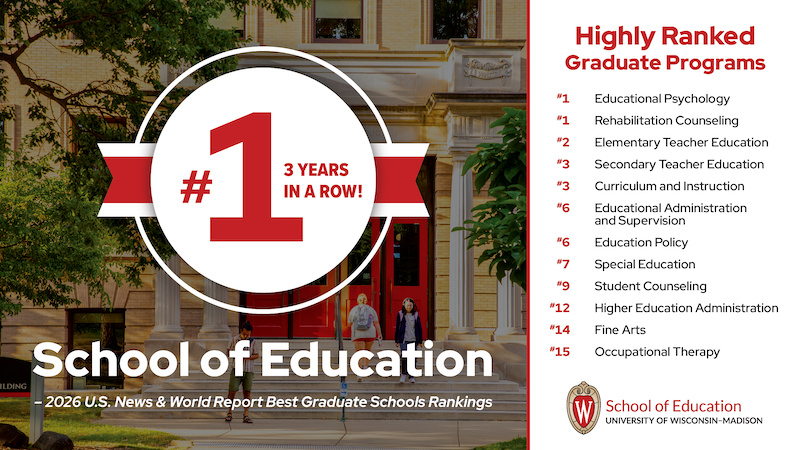
While being ranked No. 1 for three straight years is a first for UW–Madison’s School of Education, it has consistently been rated among the very best in the nation for more than two decades. The School of Education has been ranked in the top 10 by U.S. News in 26 of its past 27 rankings — and it has been ranked in the top five for 13 straight years.
Marcelle Haddix, dean of the School of Education, says the rankings highlight the School’s wide array of highly regarded programs — and recognize the innovative and impactful work carried out by its faculty, staff, students, and alumni.
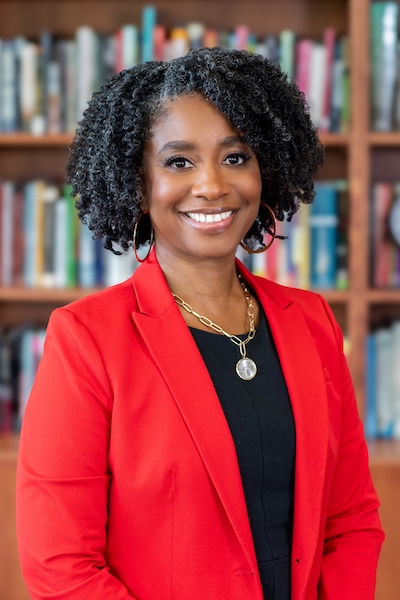
“It’s exciting to see our academic excellence highlighted across education, health fields, and the arts,” says Haddix. “Although the U.S. News rankings are but one measure of our School, they reinforce our commitment to leading nationally on pressing issues. From our ongoing efforts to address Wisconsin’s teacher workforce challenges to impactful research, meaningful engagement on topics like literacy, AI and the future of education, and student mental health — we remain dedicated to shaping a better future for all.”
U.S. News & World Report ranks nine graduate program specialty areas in the education realm each year — and once again, the UW–Madison School of Education has programs ranked in the top 15 in all nine areas: No. 1 Educational Psychology; No. 2 Elementary Teacher Education; No. 3 Curriculum and Instruction; No. 3 Secondary Teacher Education; No. 6 Educational Administration and Supervision; No. 6 Education Policy; No. 7 Special Education; No. 9 Student Counseling; and No. 12 Higher Education Administration.
The Department of Educational Psychology has consistently ranked among the very best in the nation. This year marks the ninth time since 2014 that it has been home to the top-ranked Educational Psychology program.
“This achievement recognizes our commitment to enhance the understanding of human behavior, learning, and mental health, and responsible use of AI in the classroom, along with the development and support of sophisticated data analysis tools that allow those findings to be shared across Wisconsin and beyond,” says Jennifer Asmus, professor and chair of the Department of Educational Psychology. “This ranking reflects decades of shared commitment by our faculty to engage in rigorous, innovative, and impactful scholarship, mentorship, and teaching that is truly driven by a focus on collaboration, service, and community. Our students, staff, and alumni all play a critical role in working with our stellar faculty toward this recognition.”
In U.S. News’ rankings of top health graduate programs, UW–Madison is home to the No. 1-ranked Rehabilitation Counseling program (housed in the School’s Department of Rehabilitation Psychology and Special Education) and the No. 15 Occupational Therapy program (housed in the School’s Department of Kinesiology).
The health specialty area of Rehabilitation Counseling isn’t rated by U.S. News every year. However, each time that category has been ranked since 2016, UW–Madison has been No. 1. Broadly, the goal of rehabilitation counseling is to help people living with disabilities and chronic illnesses achieve their life goals through counseling and case management.
“We deeply appreciate this recognition, which highlights the dedication and outstanding efforts of our faculty, staff, students, and alumni, whose daily work drives meaningful improvements in the lives of individuals with disabilities across our communities,” says Kimber Wilkerson, a professor and chair of the Department of Rehabilitation Psychology and Special Education.
And in U.S. News’ Best Fine Arts Graduate Program rankings, UW–Madison is No. 14. The UW–Madison School of Education is home to the Art Department. U.S. News discontinued its separate rankings of specialties within the fine arts.
Explore all of the UW–Madison School of Education’s graduate programs.
How the rankings are calculated
Writing about the methodology for its Best Education Graduate Schools rankings, U.S. News & World Report explains: “Graduate programs in education can prepare students for leadership roles at colleges, universities, state and local governments, K-12 schools, and nonprofits. To assist in the search for the best fit program, U.S. News evaluated education schools on research activity, academic excellence of entering students, faculty resources, and opinions on program quality from education school deans and school hiring professionals.”
To calculate its overall 2026 Best Education Graduate Schools rankings, U.S. News & World Report sent surveys to 510 institutions that grant doctoral education degrees. Of those, 270 responded with the necessary data and were ranked.
U.S. News & World Report derived each education school’s overall rank by scoring it on nine distinct ranking factors that broadly cover: research activity (total research expenditures and average expenditures per faculty member); quality assessment (peer assessments and educational professional assessments); faculty resources (total doctoral degrees granted, student-to-faculty ratio, percentage of faculty with awards, and graduate degrees granted-to-faculty ratio); and student selectivity (acceptance rate). Learn more about the methodology here.
The UW–Madison School of Education has a long history of excelling in research and being highly respected by its peers in the field. The School has similarly recruited, retained, and supported excellent faculty and consistently attracted outstanding students to its programs.
Education program specialty rankings, U.S. News & World Report explains, are based solely on nominations by education school deans and deans of graduate studies at education schools from the list of schools surveyed. They selected up to 15 top programs in each specialty area.
Similarly, rankings related to Health programs came from surveys provided by program directors and faculty in health disciplines. U.S. News reports that it sent surveys to 289 doctoral and master’s degree programs in OT to collect information. Respondents rated peer programs on a 1 to 5 scale of academic quality, and rankings were determined by the average of ratings each program received.
Fine Arts program rankings were also based entirely on a peer assessment of deans and top academics at 222 art and design programs.