By Laurel White
Four-year-olds have a way of lighting up a room.
That light probably comes from the spirit inherent in a disheveled hairdo, a bright and mismatched outfit, and a pair of curious eyes. A four-year-old, in peak four-year-old form, is almost guaranteed to make you smile.
That understanding was at the heart of Rocky Knoll Health Care Center’s intergenerational programming. Rocky Knoll, a skilled nursing facility in Plymouth, Wisconsin, offers short-term rehabilitation and long-term care to older adults. For the past several years, the facility has offered intergenerational programming as one of its enrichment programs for residents — the facility brings together those who live at Rocky Knoll with young children from its on-site daycare center to read stories, make art, and play games. Smiles abound.
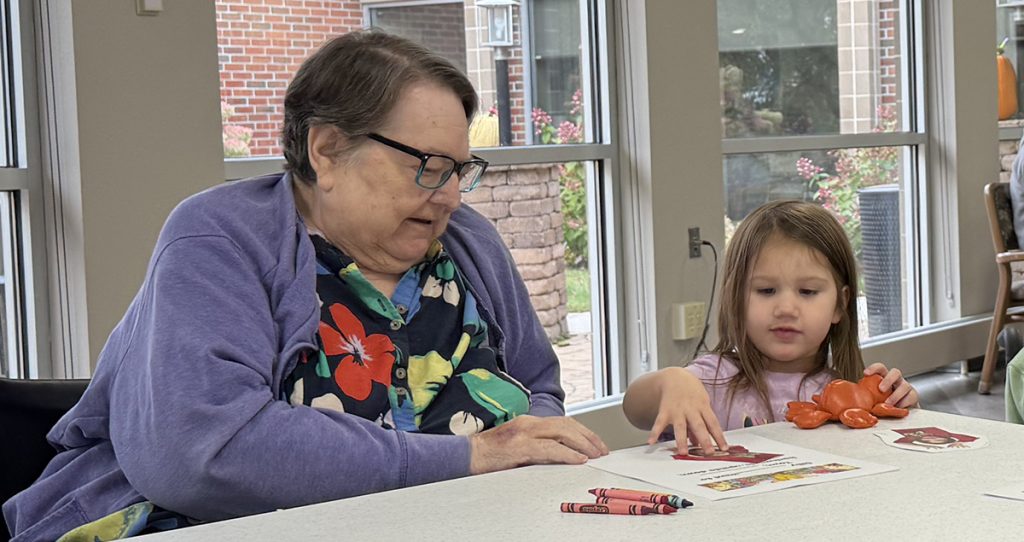
But the center wanted even more from its intergenerational programming — they knew what was great about it could be harnessed into something even better and more enriching for young and old alike.
“These programs are not just feel-good activities, but intentional practices with psycho-social benefits to the residents and developmental benefits for the children,” says Kayla Clinton, nursing home administrator at Rocky Knoll.
Clinton says the facility was interested in giving more structure to its intergenerational programming, including a sustainable curriculum for its staff to follow and ways to measure outcomes.
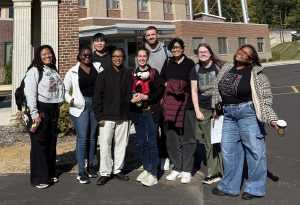
Thanks to an existing partnership between Sheboygan County and UW–Madison’s UniverCity Alliance, a UW–Madison School of Education faculty member and graduate students were able to provide Rocky Knoll what it needed. Last semester, an educational policy studies course on participatory and community-based research connected with the Rocky Knoll community to craft a community-informed curriculum and measurement tools for the facility’s intergenerational programming. The materials will serve the facility for years to come.
Naomi Mae W., an assistant professor in the Department of Educational Policy Studies, developed and taught the course (EDPOL 580) that connected with Rocky Knoll through site visits and virtual meetings. She says her goal for the course, which was offered for the first time last semester, was to provide students with hands-on experience engaging with a community.

“Students need to learn the theory with the practice,” Mae says. “I didn’t want the course to be entirely theoretical and conceptual.”
Mae acknowledges there are a number of barriers to fostering a healthy relationship between academia and a community it hopes to serve. She brought those challenges to the forefront of her class, ensuring students were aware of ways to develop and maintain practices that “do the work with no harm.”
“The students are getting to concretize what they’re learning in the classroom — these core pieces of community-engaged work, like building rapport and centering community needs,” she says.
Kayla Sippl, a graduate student in the course, says she signed up with hopes of getting hands-on experience.
“The course definitely met my expectations,” she says. “Dr. Mae’s facilitation created the space for rich class discussions around the nuances and difficulties of community-based work. This felt extremely important, as it can be easy in a classroom setting to focus on the ideals of community-engaged work while ignoring the realities that often get in the way.”
Sippl says she’ll carry many lessons from the semester forward — including how much time and self-reflection is needed to create a healthy working relationship between scholars and communities.
“These are key components of a university–community partnership, yet they are often easy to rush or overlook,” she says.
Mae says her course may connect with Rocky Knoll again, but other partnerships fostered by UniverCity Alliance are also on the table. As a scholar who has dedicated much of her career to studying and implementing community-engaged work, she looks forward to continuing to bring the spirit of the Wisconsin Idea alive.
“I built this course around the idea that we could fulfill what the community needed, and I could fulfill what the students need to learn,” she says. “It’s an honor to put this into practice.”