Throughout the semester, we’re shining a light on the Art Department’s graduating MFA candidates as they present their final thesis exhibitions. These exhibitions are the culmination of years of dedicated study and artistic exploration, showcasing our students’ diverse talents and innovative approaches to art-making.

Matt Bruhn creates furniture and sculptural objects that “exist between function and autonomy.” A dyslexic artist, Bruhn describes first understanding the world through spatial reasoning, touch, and play, drawing a connection between childhood building blocks and his current hands-on practice. Working primarily in woodworking, he uses traditional craft methodologies to create forms — zigzags, squiggles, and varied structures — and explores how they relate through connections and composition.
Bruhn’s thesis exhibition, “13 Pretty Things,” will be on view April 7–12 in Gallery 7 on the seventh floor of the Humanities Building. A reception, which is free and open to the public, will take place on Friday, April 10, from 5–8 p.m.
We asked Bruhn to share more about his work:
What inspired you to create this work?
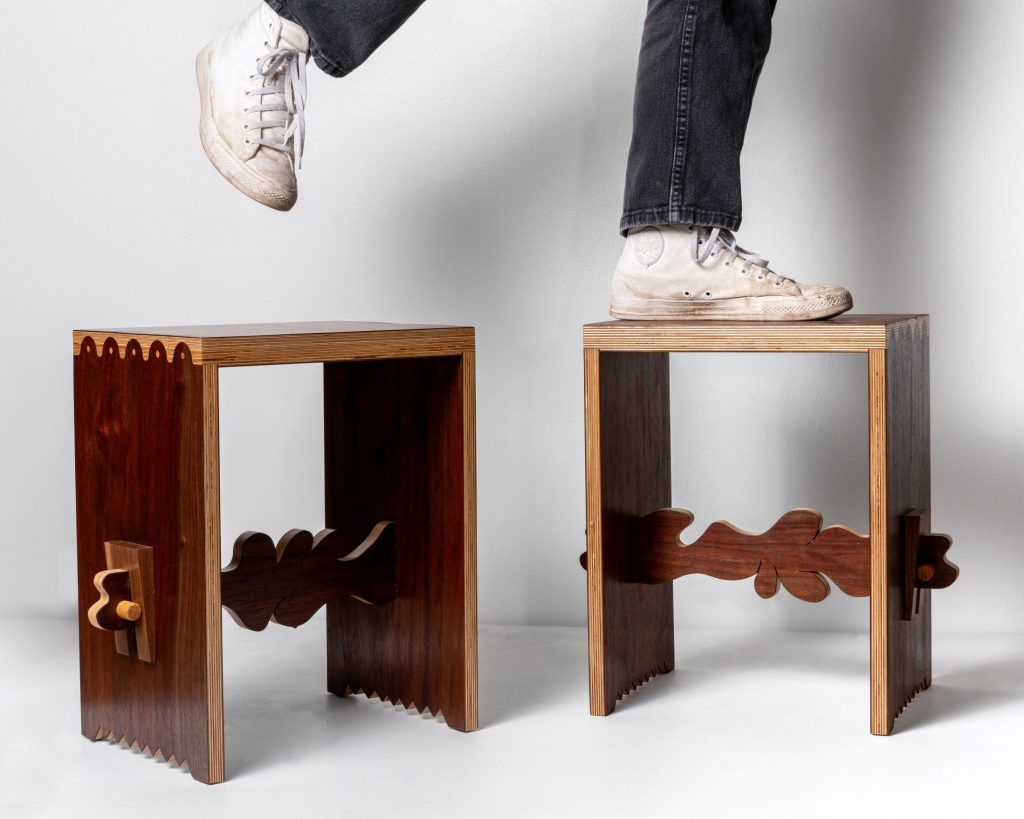
Originally inspired by a desire to breathe new life into the Knapp joint, a once common method of joinery displaced in the early 20th century by the dovetail jig, these works assemble a range of dissonant parts, functioning as both technical study and formal exploration. Forms drawn from 1960s psychedelic graphic design, children’s construction toys, and experimental joinery converge in compositions that are at once refined and whimsical.
How did you create it?
Constructed from hand-cut walnut veneer applied over Baltic birch plywood, the stools juxtapose distinct material languages embedded in contemporary material culture. Plywood, ubiquitous in commercial production and construction, reads as familiar, even pedestrian. In contrast, the heavily worked walnut veneer foregrounds the presence of the hand, introducing intimacy and irregularity.
What do you hope viewers take away from your exhibition?
By staging tension between industrial substrate and tactile surface, the stools invite reflection on how objects are made, how labor is valued, and how the built environment might be reconsidered.