By Maggie Ginsberg, Division of the Arts
Last summer, during the first week of the Madison Metropolitan School District’s Summer Arts Academy, the gymnasium inside Thoreau Elementary School was crawling with restless second graders. They were hot, distracted, and a little shy.
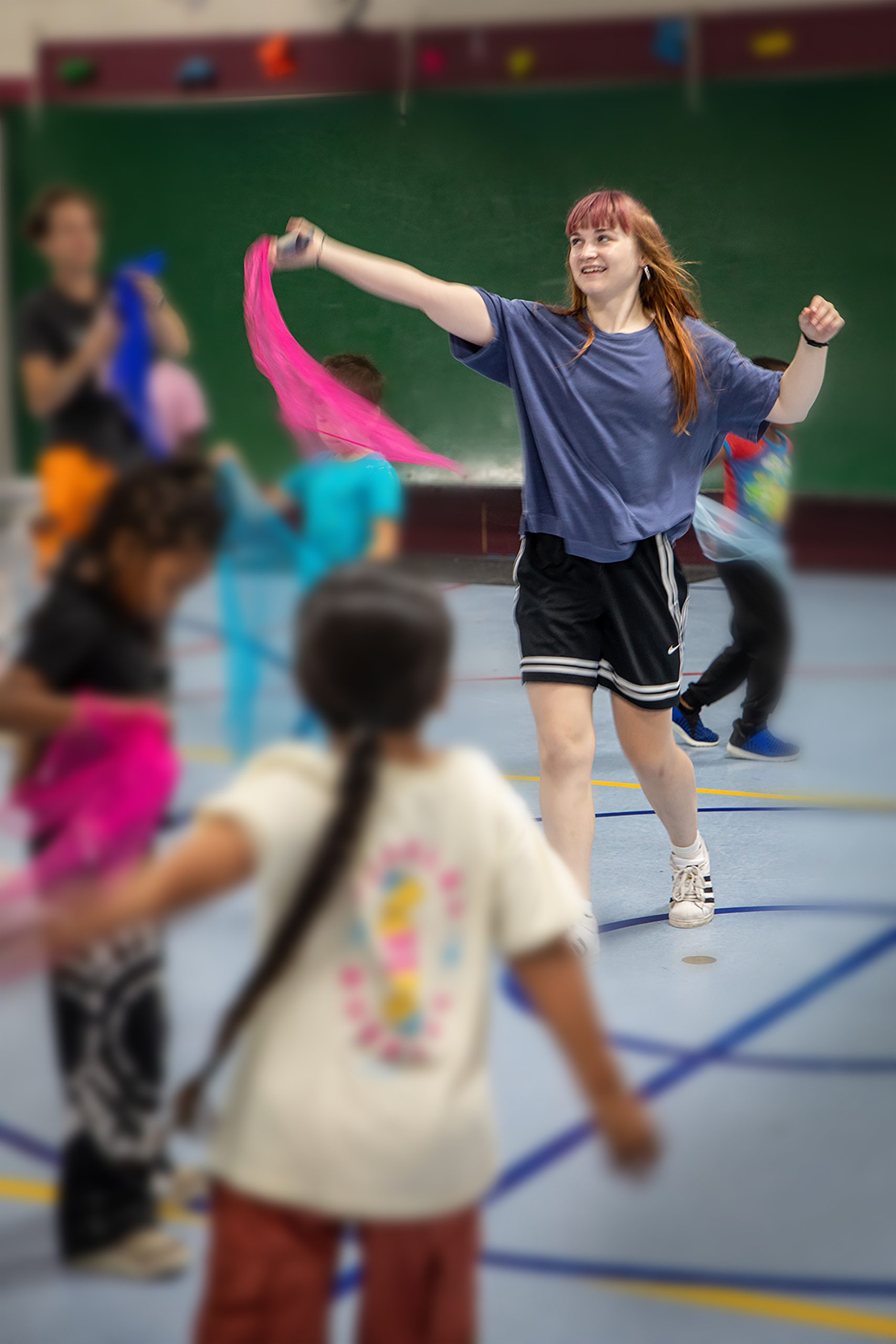
“Let’s form a circle,” said lead teaching artist Abbey Brooks, who wore a red UW Dance Exchange T-shirt, pink hair, and a warm smile. Along with Vivian Simpson, a dance major, they settled the kids cross-legged in a circle at center court. One by one they introduced themselves by sharing the languages they spoke, an intentional component of the curriculum that celebrates identity.
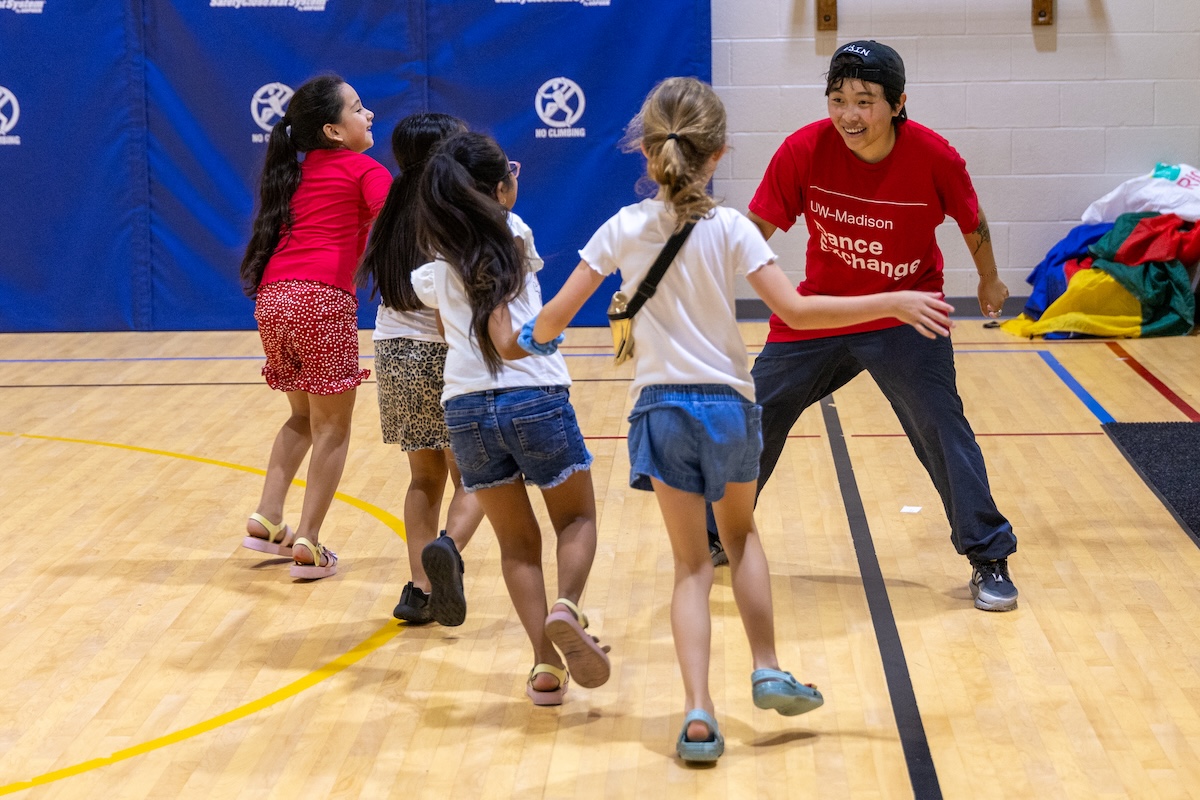
As the bass dropped on a lively playlist — everything from “Si Antes Te Hubiera Conocido” to “Tick Tick Boom” — Brooks and Simpson led the kids through hip-hop forms like ATL Stomp and imaginative games like Freeze Dance. At the end, the kids returned to the circle, flopping onto their backs to allow their hearts, lungs, and busy brains to resettle.
“That was hard,” one said to another.
“That was easy!” the kid said back.
This marked the third year that MMSD’s Summer Arts Academy enlisted UW Dance Exchange, a unique, collaborative effort that pairs UW–Madison students with local teaching artists to bring free dance instruction into public schools. Members of UW Dance Exchange rotated between 12 MMSD schools to work with elementary and middle school students teaching moves, encouraging creative play, and nurturing relationships. They showed kids — especially those who can’t afford studio classes, or who struggle to stay engaged in school — what dance can do for them, and why it matters. Above all, they had fun.
UW Dance Exchange is the vision of Chell Parkins, Arnhold Director of Dance Education. If it was up to her, dance would be taught in all public schools, just like it used to be.
Leading the way
Parkins joined the Dance Department in 2022 in part because UW–Madison pioneered dance instruction in public schools. Those programs all but disappeared as arts funding was cut. How poetic would it be if the university that started it all could lead the country in bringing it back?
Parkins assessed needs with Wisconsin’s Department of Public Instruction, then designed the two-year, 14-credit Certificate in Dance Education. In 2024, she started UW Dance Exchange summer programming, hiring Patricio “Pato” Cierna, an Argentinian hip-hop dancer working at Barrio Dance Studio. (Barrio was founded by Dance Department lecturer AJ Juarez. Brooks teaches there as well.)
“I wanted to create a program where I’m working with highly skilled teaching artists in the community who maybe don’t have that educational dance pedagogy component, but would be open to developing that aspect of their teaching,” Parkins says. “I was also looking for teaching artists that represent non-dominant identities and dance forms that are relevant to the kids’ backgrounds, because there is such a high need. MMSD public schools are 18% Black, 24% Hispanic or Latino, and we also have a large Hmong population here.”
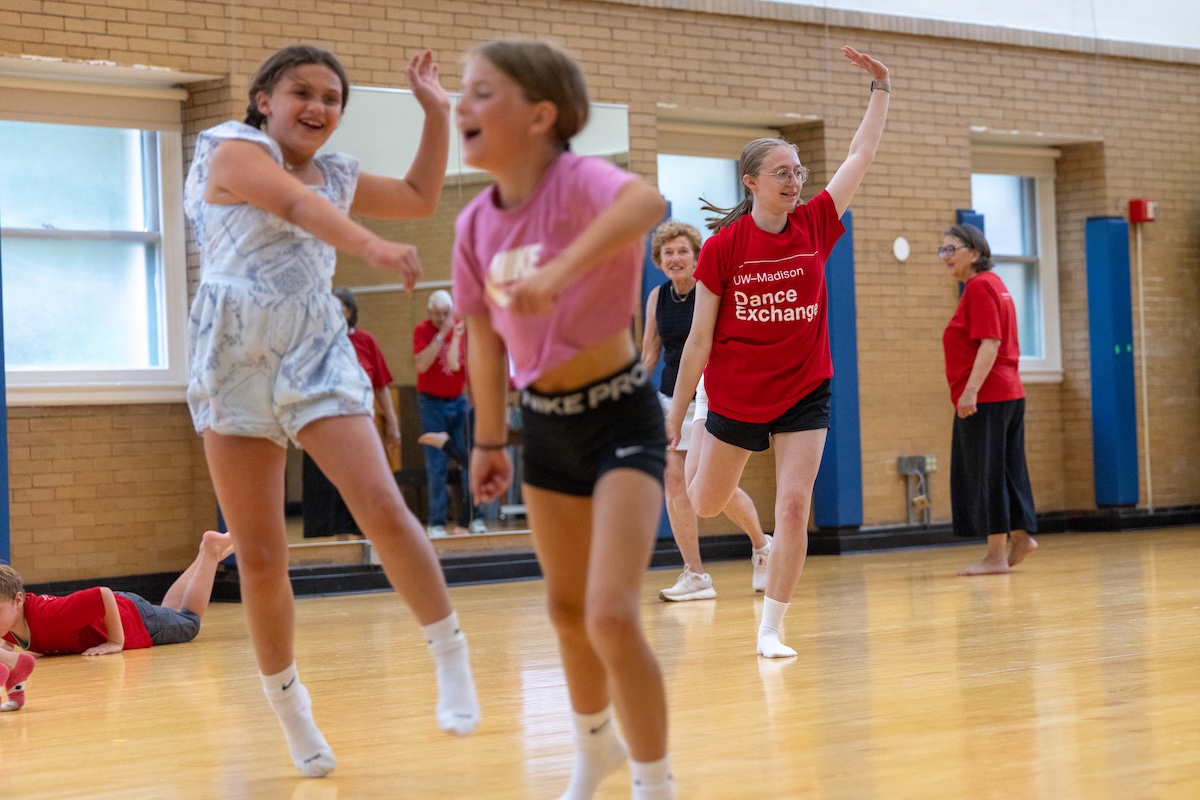
Now, six MMSD schools also enlist UW Dance Exchange during the academic year. Each requests different socialemotional, culturally responsive programming based on its student populations, such as Spanish-speaking or Hmong students, or kids who are unhoused. UW Dance Exchange delivers a developmentally appropriate curriculum that feels fun to kids. UW students glean teaching experiences in a public school setting, and teaching artists are exposed to academic approaches like lesson planning and child-development standards.
“It really is this little microcosm with different pieces that feed each other — students, teaching artists, schools, families, public school teachers,” Parkins says. “And I think it gives our UW students this unique and important perspective on how we can do this work in communities and schools.”
Creating access to dance for all kids
Sabrina Bonine is one of those UW students. Although Bonine grew up taking studio classes, they always relied on scholarships. Bonine chose UW–Madison because it offered one of only two full dance majors in Wisconsin, and opted for a double major in elementary education out of a desire to make dance more accessible. Fortuitously, the Certificate in Dance Education launched Bonine’s junior year. Bonine was one of the first to sign up, and joined UW Dance Exchange its second summer. Now Bonine will be the first graduate of the new Certificate in Dance Education.
“This program really gives me the opportunity to physically practice my hands-on teaching in a way that otherwise I would have to wait until my dance education practicum,” Bonine says. “This is not something that most public schools have access to, especially in Wisconsin. This allows these kids to see that dance is for every single person, no matter your situation.”
That sentiment resonates with Pa Ying Gia Thao, a dance major pursuing a Pilates certificate.
“I didn’t get dance at all, or lessons for anything outside of school — we could never afford it,” Thao says. “So seeing it in this setting, and being part of providing that for people? I really appreciate that this exists.”
When Thao came to UW–Madison, she learned the history and cultural significance of breakdancing through classes with Assistant Professor Omari Carter. UW Dance Exchange gave her teaching experience, and she loves representing the culture to kids. Thao is a proud B-girl — a rare female dancer in breaking — and the only Hmong B-girl she knows.
“There was this little girl in my class trying so hard to get this ‘Baby Freeze,’ and she finally got it, and she was like, ‘I love the Baby Freeze because it tells me to never give up,’” Thao says of the classic breaking move. “I want them to discover themselves.”
Full circle summer
That joy and discovery was evident toward the end of the Summer Arts Academy, when Thao took her turn with the second graders at Thoreau. They played “crabs and spiders,” a fun version of tag where they scrambled around on their hands and feet — practicing, whether they realized it or not, the building blocks of breakdancing. Thao demonstrated a series of moves — four two-steps, two side-steps, two kickouts, and a freeze — then cranked up the music to put it all together. After class, Thao gave fist bumps to each kid. “You were amazing. You gave 100%,” she said. “And if you didn’t today, then maybe tomorrow.”
From the sidelines, Thoreau Principal Emily Jensen watched. “The kids really, really like it,” she says. “They’re all engaged, there’s nobody sitting out. It’s opening them up to different cultures, diversity, and opportunities they don’t get out in the community where they’re not getting dance class.”
Thoreau students are among the lucky ones that continued the UW Dance Exchange program during the school year, thanks to the PTO, which pays for four days of instruction during phy ed class. “For us, it comes down to funding,” says Jensen.
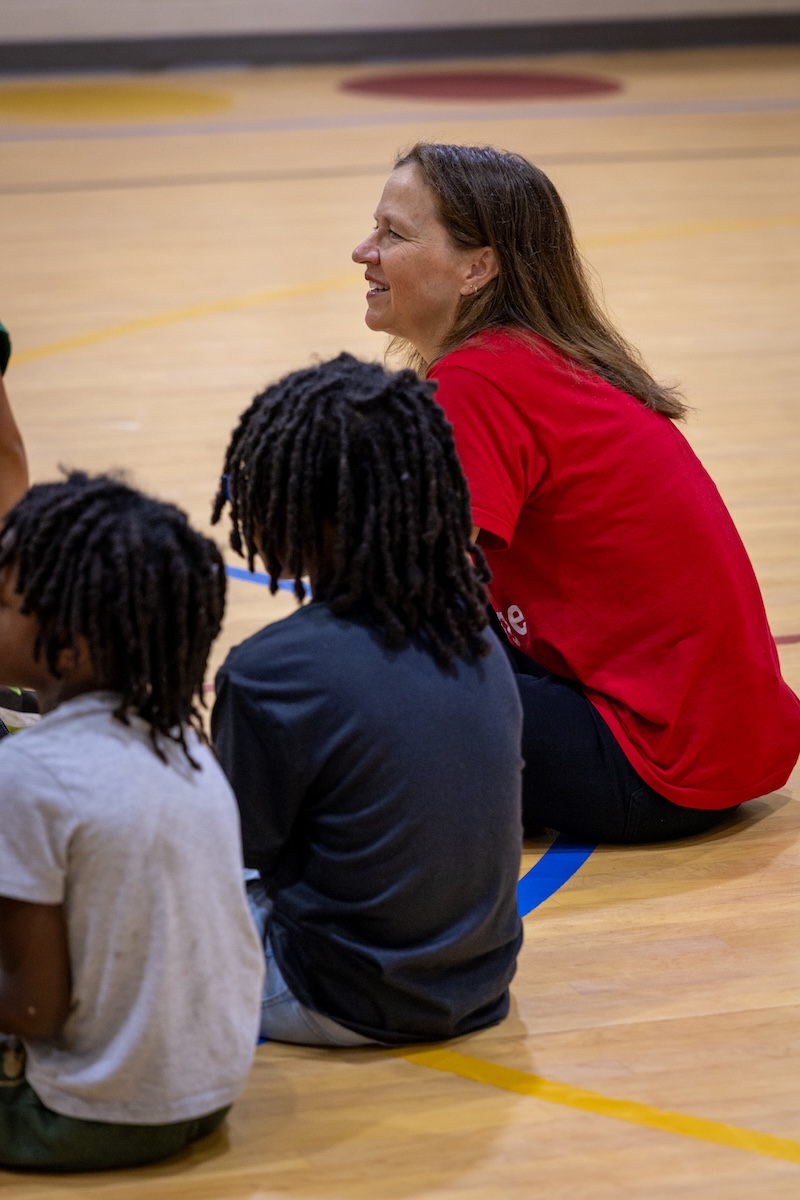
Parkins says that Thoreau is unique in that financial support from parents. “Most schools use district funds, and not all schools can afford our programs,” Parkins says. “We find other ways to fund those programs.”
One way came in the form of the 2025 Joyce J. and Gerald A. Bartell Award in the Arts, awarded to Parkins for UW Dance Exchange. She applied the funds to an MMSD elementary school that has the highest unhoused population in the district, one that couldn’t afford the program without it.
New this 2025-26 academic year, the School of Education’s Office of Professional Learning and Community Education (PLACE) is providing structural support. Parkins hopes that as more schools engage the UW Dance Exchange curriculum, it will naturally seed future practicum opportunities for her certificate students. But the most rewarding aspects are the hardest to quantify.
“It’s incredible when the schools tell us how happy they are. When they say, ‘This kid never shows up in the way that they’re showing up here,’” Parkins says. “Or, ‘That kid just lights up when he comes here.’ It’s an incredible gift.”