“cullud wattah,” a powerful and award-winning play by UW–Madison alumna and First Wave graduate Erika Dickerson-Despenza, is the latest production from University Theatre, opening Feb. 26.
Set in 2016, the play unfolds 936 days into the Flint, Michigan, water crisis. When third-generation General Motors employee Marion is on the verge of a promotion, her family is thrown into conflict as her sister begins protesting the very corporation Marion depends on for economic security. As the city’s water crisis deepens, the family of Black women must confront their past, their survival strategies, and the cost of silence.

Told through a non-linear structure, the play explores how time, choice, and systemic injustice shape our lives. Dickerson-Despenza explains the play was sparked by Flint resident Loui Brezzell, who posted on social media that it took 144 bottles to prepare Thanksgiving dinner for seven people. “Her post made clear the material consequences of the crisis in a way that had not been widely acknowledged,” she says.
Dickerson-Despenza describes “cullud wattah” as an effort to illuminate “the rupture of government intervention at the intersection of capitalism, environmental racism, and industry-government collusion — and its impact on Flint’s most vulnerable residents: poor, Black (pregnant) women, single parents, the elderly, the undocumented, the disabled, and children. The play is a story about orderers of chaos working against a highly synergized socio-environmental backdrop.”
Originally recommended to University Theatre by Professor Emeritus Sandy Adell, the production offers a timely opportunity for campus and community dialogue around environmental justice, race, public policy, and artistic activism.
Aly Amidei, the artistic director of University Theatre and an associate professor in the Department of Theatre and Drama, describes the play as a meaningful choice. “Erika Dickerson-Despenza’s work — and her legacy at UW–Madison — invite community, conversation, and connection,” she says. “The play allows us not only to celebrate the strength and resilience of this family of Black women, but also to reflect on the real communities and activists connected to the ongoing water crisis in Flint.”

The production is helmed by Chicago-based director Ilesa Duncan, producing artistic director of Pegasus Theatre Chicago and leader in ensemble-driven, socially engaged Black theatre practices. She sees the play as both urgent and imaginative.“‘cullud wattah’ is a painful reminder of the thoughtless decisions the powers that be make that wreak irreparable damage upon Black, working class, and poor communities,” says Duncan. “At the same time, Erika’s play is deeply soul-stirring and wildly imaginative. I love how she incorporates a choreo-poetic style and combines what critic Juan Ramirez calls the ‘personal, familial, and political’ to tell the story of a Michigan family struggling to overcome the devastating impact of the Flint Water crisis.”
“I think audiences will be riveted by this family’s story, the playwright’s beautiful storytelling, and engaged with the wonderful cast bringing her play to life.”
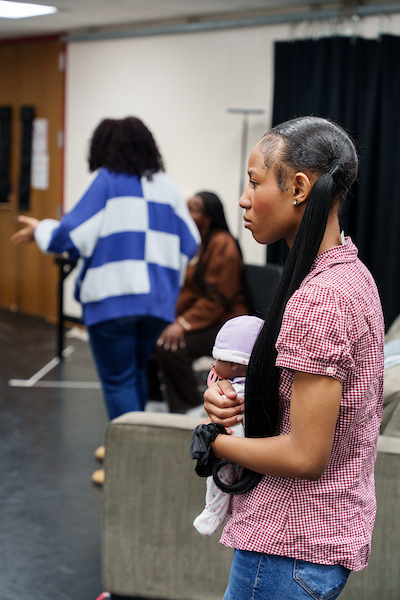
The creative team includes Chicago designers Manuel Ortiz (scenic design) and Brenden Marble (lighting design), alongside a cast and crew of talented UW–Madison students, faculty, staff, alumni, and community artists. “They are bringing a wonderful matrix of perspectives to the work,” says Duncan.
Dickerson-Despenza says she is “elated” her work is being produced by her alma mater, where she studied English secondary education and was a member of the third cohort of First Wave, UW–Madison’s hip-hop and urban arts scholarship program. While a student, she also took classes in the Department of Theatre and Drama. The production “feels like a homecoming of sorts,” she says.
While the play has been widely produced at regional theatres across the country, UW–Madison is only the second university to stage it; the collegiate premiere was at the University of Kentucky.
“It’s an honor, just as it was to receive the Wisconsin Alumni Association’s Forward Award in 2022,” says Dickerson-Despenza. “Above all, I am most proud of providing substantial roles for five Black women students.”
During her time at UW–Madison, Dickerson-Despenza was extremely active on campus. In addition to First Wave, she served on the Black Student Union executive board, joined the Zeta Xi chapter of the Delta Sigma Theta Sorority, Inc., worked as the publications coordinator for Women in Redzine, and founded The Colored Girls Project. “Through these organizations, I was able to hone my skills in writing, performing, and producing events, productions, and a literary magazine — activities that were a springboard for my career now.”
“cullud wattah” runs Feb. 26 – March 8 in the Ronald E. Mitchell Theatre in Vilas Hall (821 University Ave.). Full-price tickets are $28, with discounts available for children, seniors, and UW–Madison faculty, staff, and students.
Buy tickets at artsticketing.wisc.edu or by calling 608-265-2787.